One people, one crown
The moment many kingdoms became one nation, and the reason there's a birthday to mark at all.
About the movement
What happened in 927, what we're asking for, and why everyone is welcome to celebrate it.
How one kingdom was made
For centuries, this island was a patchwork of rival kingdoms (Wessex, Mercia, Northumbria, and more) with the north held by Viking rulers. In 927, one man manage to bring them all together.
Æthelstan, grandson of Alfred the Great, took the city of York from the last Viking King. Then, at Eamont Bridge near Penrith on the 12th of July 927, the other Kings of Britain came to acknowledge his overarching rule over all. For the first time, a single King ruled all of England, styling himself Rex Anglorum: "King of the English."
It is the closest thing we have to the day England was born.
He was more than a conqueror - Æthelstan gathered scholars, issued some of the earliest English law codes, reformed the coinage, and built alliances across Europe. The kingdom he made has outlasted him by nearly 1,100 years, and everything that followed grew from that beginning.
Older than the kingdom
The English were a people long before England was a place.
However, the people themselves are far older than the name. The island has been continuously inhabited since the ice sheets retreated, around 10,000 years before Christ. When Caesar led his first military incursions in 55 BC, the Britons he found had already been here a hundred centuries. Rome came and went. The Angles and Saxons came and stayed, and it was their name that endured, but it settled over a population that was already ancient, and within a few generations there was no meaningful line between any of them. They became one people, and the name they took was the English.
That is what the name did: it did not land on an empty island, it gave a single identity to everyone already living here, and that identity is what became a country in 927. To this day, some research points to perhaps as much as 70% of the native population still having DNA from the original Britons. Even when the Romans finally invaded in 43AD, they named their first province Britannia, personified on Hadrian's coins from AD 119, depicted as a woman in a native cloak, with a shield and spear by her side. The Romans acknowledged the people who lived here even then, 850 years before Æthelstan.
Not a lone conqueror
Æthelstan did not do it alone, and there's a lot more to it than just his part of the story. He was born into the middle of a project three generations deep. Alfred the Great saved Wessex and drew western Mercia in through the marriage of his daughter, Æthelflæd. After the death of her husband, Ealdorman Æthelred, she ruled western Mercia in her own name and campaigned as the Lady of the Mercians. Æthelstan's father, Edward the Elder, was her brother, whilst Æthelflæd herself, was Æthelstan's aunt.
The bond was stronger than blood alone, with William of Malmesbury recording that Alfred sent his eldest grandson to be educated at Æthelflæd's court, so Æthelstan grew up fostered in Mercia. That upbringing gave him deep Mercian roots, and it is why he could later hold Wessex and Mercia together as one people, rather than as conqueror, and the conquered.
Between them, Edward and Æthelflæd brought East Anglia and the Five Boroughs of the Danelaw under the control of Wessex, and Mercia. On Æthelflæd's death, Edward moved quickly to absorb Mercia itself, and by the time he died, he ruled every Anglo-Saxon kingdom south of the Humber. Æthelstan inherited the kingship of more territory than any Anglo-Saxon ruler had ever held.
However, the family had never held the North. The Viking kingdom of York, and Northumbria with it, stood outside everything Alfred, Æthelred, Edward, and Æthelflæd had built. Taking it was Æthelstan's own act. When Sihtric, the Viking King of York, died in 927, Æthelstan seized Northumbria and York and became the first man to rule all of the English: Rex Anglorum. Then, on the 12th of July 927, the kings of Alba and Strathclyde and the other Northern rulers, came to Eamont Bridge near Penrith, to acknowledge him.
The inheritance was the springboard. The creation of England was his own.
That is why the founding of England is worth telling properly. The country was not made by one man, giving one new name, in one year, but by one family working across three generations, and at the heart of it stands Æthelflæd: a woman who ruled and campaigned in her own name, and without whom there would have been no England at all. A woman was as prominent in the formation of this country as any man, and arguably led the groundwork that led to it.
The proposal
We're asking the Government to mark England's 1,100th birthday by creating an English History Month each year, beginning on the 12th of July, with a national holiday on the day itself.
A month to learn, share, and enjoy the stories, traditions, and achievements that shaped this country. Most nations pause to remember where they came from. England, oddly, has never had even a single day that is simply its own, and many of its traditions have simply disappeared over time as a result. This would be that day, and it will help revive those traditions, with a season around it for schools, museums, towns, families, and visitors, to take part however they like.
It is deliberately not political. It isn't aimed at anyone in particular, and it doesn't belong to any party or faction. We don't care who you are, what you believe, or where you live. This is a birthday, and everyone's on the guest list.
What we'd celebrate
The moment many kingdoms became one nation, and the reason there's a birthday to mark at all.
The idea, written down here first, that even a King must answer to the law. It echoes in constitutions the world over.
Arthur's table was round so that no Knight sat above another. An ideal of fairness and equality we still reach for.
Courtesy, fair play, and the duty to protect those who cannot protect themselves: the conduct of a Gentleman and a Lady, the beating heart of England.
From Newton to the steam engine, the jet, the first computers, and the World Wide Web. Invention born here that reshaped how everyone lives.
Britain abolished the slave trade and sent the Royal Navy to hunt it down across the oceans: a fight to end an injustice, carried far from home.
Britain went to war not because it was attacked, but to keep its word to an invaded ally, choosing principle over safety.
The songs, tales, feasts, and folk customs handed down through generations: the everyday inheritance that makes a place feel like home.
From Chaucer to Shakespeare to the King James Bible, a language that grew here, and now belongs to billions.
The saint and the flag
England has been a nation since 927, roughly six hundred years before the red-and-white cross became its flag. The country came first. The saint and the flag were adopted long afterwards.
Saint George never set foot in England. He was a Roman soldier of the third century, martyred in the eastern Mediterranean around the year 303, and he is honoured by many nations: Portugal, Georgia, Catalonia, Genoa, and more. He belongs to all of them, not to England alone.
The red cross on a white backgroundwas a Crusader emblem, and the flag of the Italian city of Genoa, well before England ever used it. English soldiers took it up as a battlefield mark in the late 1200s, and St George was made England's patron saint in 1348, replacing the older English saints Edmund and Edward.
It only became England's own flag during the Reformation.
In the 1500s, as the country set its own course and the old patchwork of saints' banners was laid aside, the St George's cross rose to stand for the whole nation: one flag for one people. That was the moment it stopped being one saint's badge among many and became the flag of England itself: a single, shared emblem of a nation that had, by then, already existed for six centuries.
Older still
Before the cross, there was the dragon.
Older than the flag we know is the emblem the English carried before it: the Golden Dragon of Wessex: the kingdom of Alfred and Æthelstan that forged England itself.
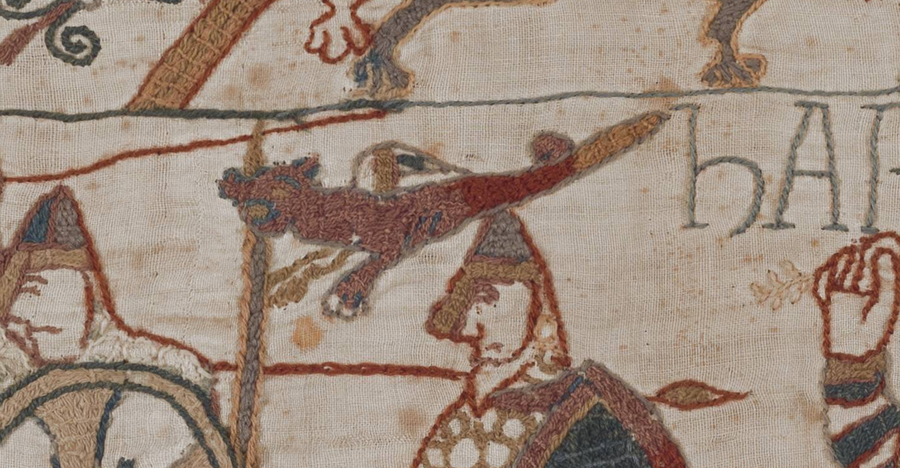
The English army at Hastings in 1066 fought beneath a dragon standard, and the Bayeux Tapestry, stitched within a few years of the battle by English hands, shows it: a golden dragon carried upright by an English soldier at the climax of the battle. It is one of the oldest images of an English battle emblem that survives.
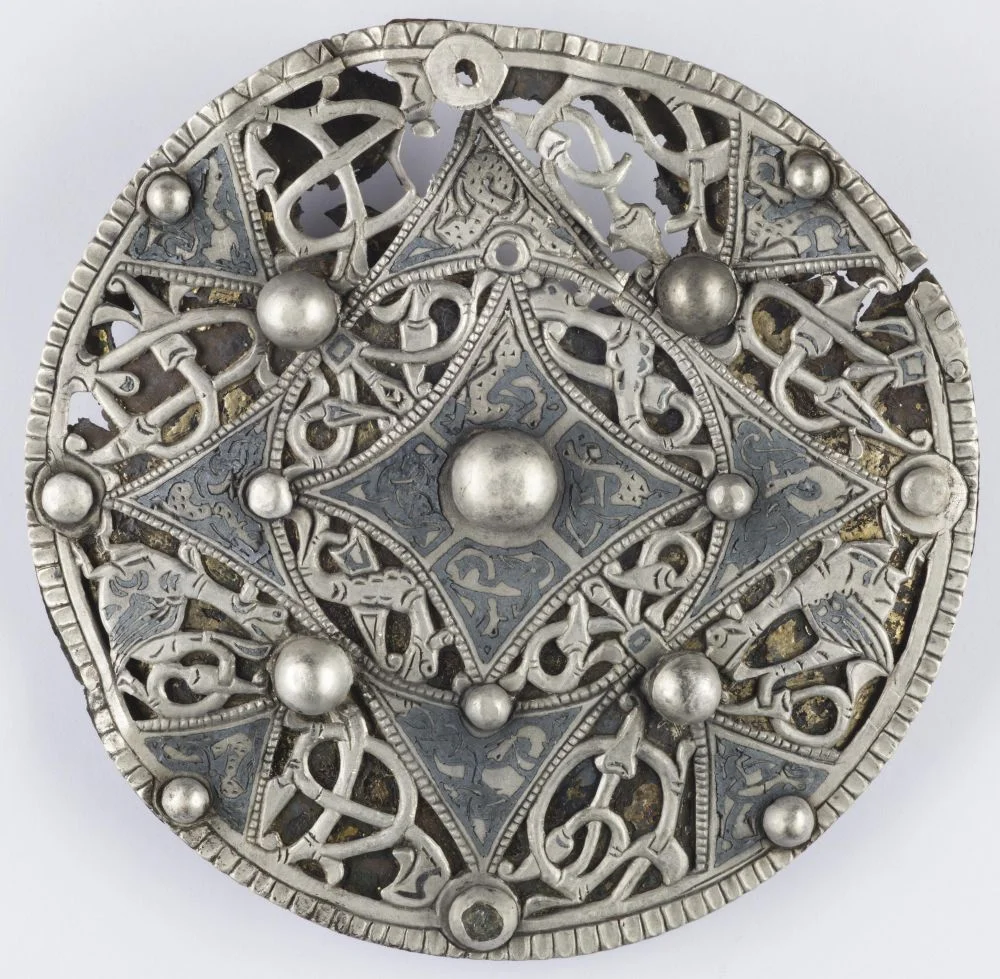
That golden dragon was the standard of the Kings of Wessex. The chronicler Henry of Huntingdon records it carried into battle as far back as the year 752, and in 2020 a silver disc, the Cheddar Brooch, made around the year 900, was found in Somerset, in the very heart of Wessex where Alfred rebuilt his forces, worked with the same two-legged wyvern. The emblem was real, and it was ours.
Some historians argue that, flying over the English army at Hastings, the golden dragon was in effect England's first national flag, six centuries before the cross. It is the older, deeper, home-grown emblem: the one that truly belongs to the story of 927.
The emblem of an age
The golden dragon was the war-standard of the English in the very age the nation was born, carried by the
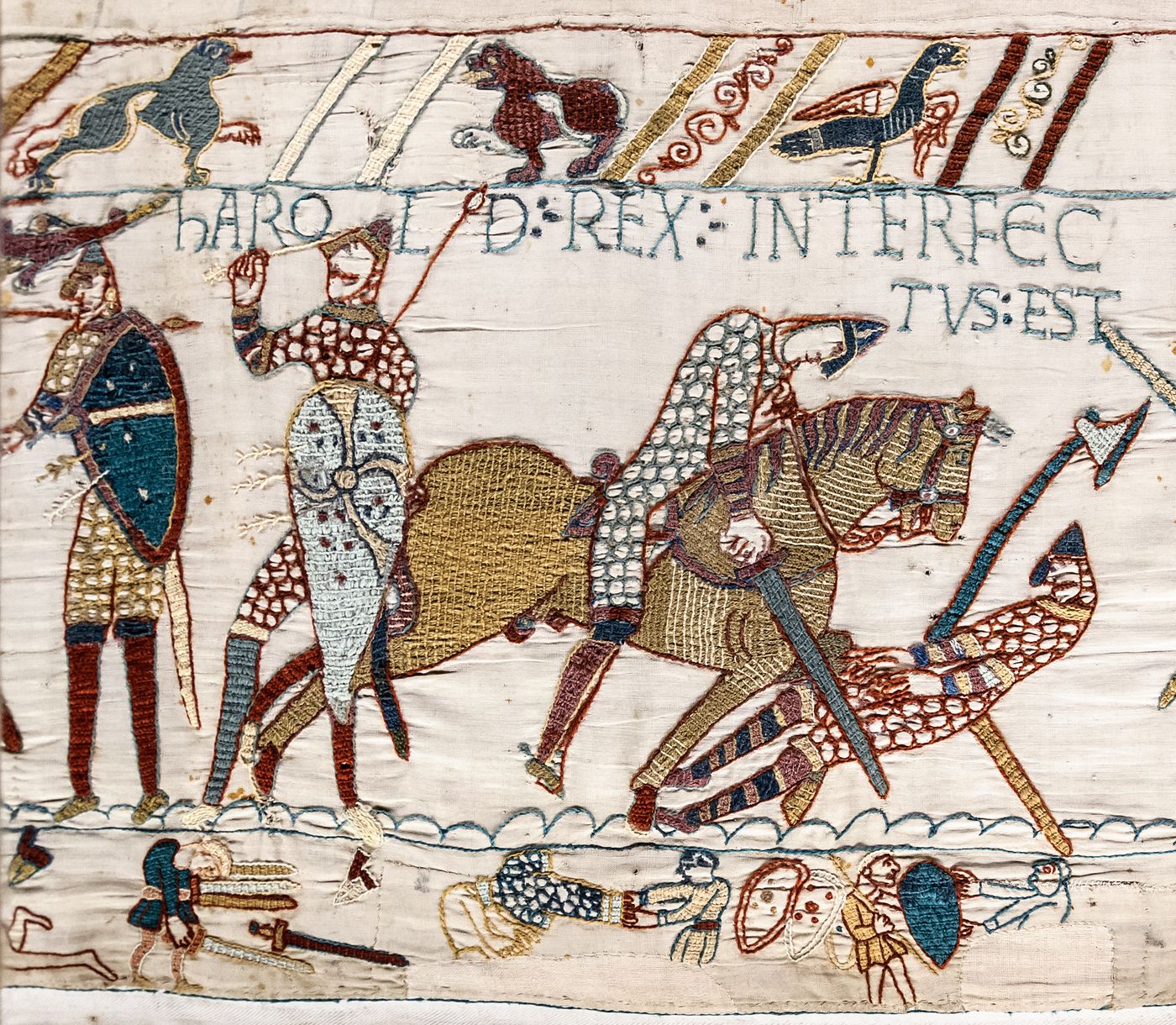
Kings of Wessex, the house of Alfred and Æthelstan that forged England in 927, and still flying over Harold's army at Hastings, where the Bayeux Tapestry shows it borne upright at the battle's climax. (Its colour in the worn wool is argued over: gold, white, or gold-and-white. But it is the gold dragon of the English, not the red dragon of Wales.)
The use of a dragon was already ancient by the time the Kings of Wessex had adopted it. The dragon standard began as the Roman 'draco': a windsock with a bronze dragon's head that hissed as the wind filled it, carried by the cavalry of the late Empire, and left behind in Britain when Rome withdrew. The Britons kept it, the Anglo-Saxons kept it, and it passed down the centuries as the sign of a war-leader.
Legend gave it an origin to match. Writing in the 1130s, Geoffrey of Monmouth told how Uther, father of King Arthur, saw a great star trailing a ray in the shape of a dragon, had two dragons wrought in gold, and took from it the name Pendragon - "Chief Dragon." It is perhaps just a story, not a proven record, and Arthur and Uther may only belong to legend, but the tale grew up around the emblem rather than the other way round, which was fitting of the time. This was an age before personal heraldry, before coats of arms and family banners, when no King had a flag of his own. The golden dragon belonged to no single man; it was the sign of a people. Which is exactly why it is the truest emblem England could carry from the year it began.
Fair questions
If you are wondering what this is not, who it belongs to, or how the harder parts of English history fit in, we have answered that plainly.